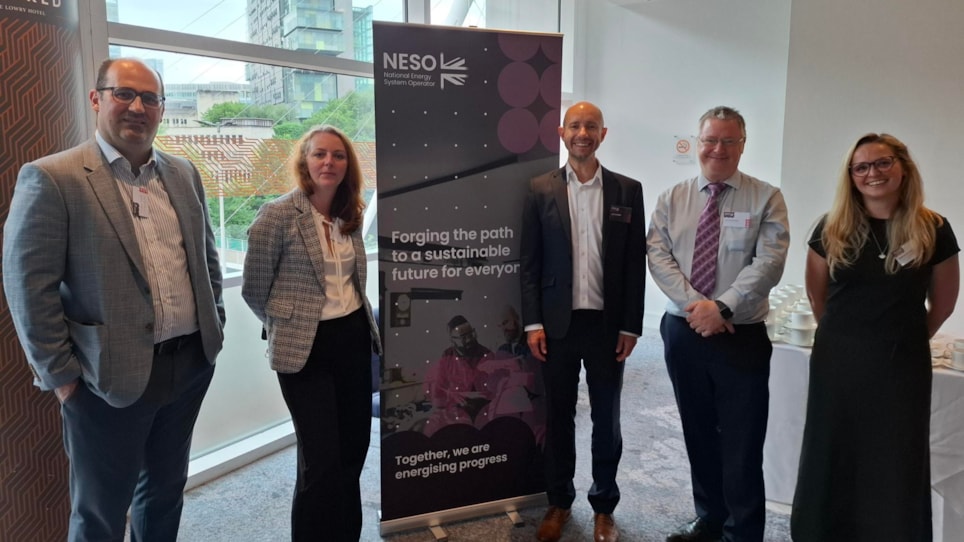
Photo: (l-r) SP ENW's Christos Kaloudas and Lynn Tracey, with NESO's Jonny Sadler (centre) and SP ENW's Paul Auckland and Bex Drakeford.
Blog by Paul Auckland
One of the main messages I shared at NESO’s forum this week was that by deepening whole systems coordination and integrated network planning, we can meet our region’s energy needs in the most efficient way, and most importantly strive to keep our customers’ energy bills as low as possible.
I joined the panel at the NESO transitional Regional Energy Strategic Plan (tRESP) update for the North West, ahead of the publication of the RESP methodology later this year.
I was joined on the panel by:
- Bridget Hartley, Head of RESP, NESO
- Jane Gaston, CEO, Net Zero North West
- Lorna Millington, Strategic Network Planning Manager, Cadent
- Russ Bryans, System Design and Development Manager, SPEN
Ultimately working to support all of our customers, partners and stakeholders to decarbonise and embrace the energy transition in a fair and seamless way, is key to the work we’re doing at SP ENW, and specifically within our Distribution System Operation DSO functions.
We know our region’s strategic energy needs well as we pride ourselves on our engagement and collaborative working practices. It’s this coordinated way of working that ensures we find the right solutions for the communities we serve. People are always at the heart of what we do and the work we’re doing to support the tRESP and RESP is no different.
As Bridget Hartley, Head of RESP at NESO said: “Regional events have really demonstrated the power of being place-based and a collaborative approach to building these plans is going to be hugely important.”
We’ve been responsive to the needs of the North West and our existing five million customers and also recently secured approval for an additional £200 million to support the fast-moving and significant growth in the region.
We invest £1 million a day into our network and the work the DSO is doing not only supports the changing way in which we use and manage our electricity, but it also works to make our existing assets work more efficiently by using advanced technology based on defined data and research.
Finally, I wanted to touch on the fact our next business plan, starting in 2028 and running through to 2033, is being jointly developed with our colleagues at SP Energy Networks (SPEN), whose electricity distribution networks covers part of Scotland, the North West and Wales.
And, if we get this right, and the RESP is enhanced by the breadth of continuing participation and engagement we share with many stakeholders from local government, industry and communities, we won’t just deliver an energy system fit for the future, we will enable jobs, growth, even more electrified transport and lower costs for consumers across the North West and beyond.